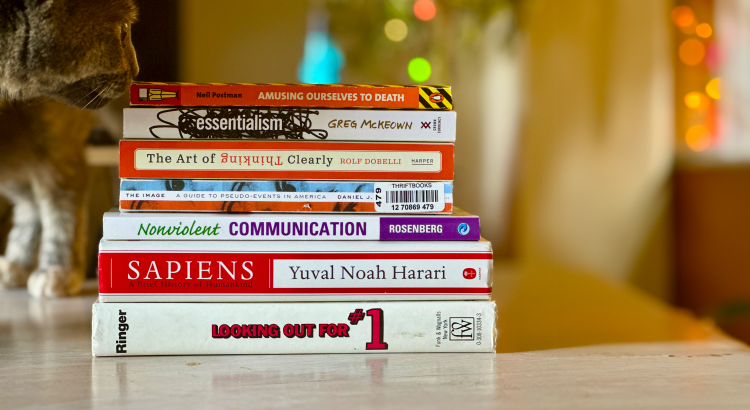
As of now, these are the books I keep coming back to.
They are in no significant order.
And if you buy them from the links below, I’ll make 13 cents on the internet!
The Art of Thinking Clearly
By Rolf Dobelli
2013
Sometimes I say this is my favorite book. Either that, or his other one: The Art of the Good Life.
Each of the 99 chapters are mini-essays on separate cognitive biases — all written from the point of view of a super-analytical Swiss dude.
Chapter 1, on survivorship bias: “In daily life, because triumph is made more visible than failure, you systematically overestimate your chances of succeeding. […] Behind every popular author, you can find a hundred other writers whose books will never sell. Behind them are another hundred who haven’t found publishers. Behind them are yet another hundred whose unfinished manuscripts gather dust in drawers. And behind each one of these are a hundred people who dream of—one day—writing a book. You, however, hear of only the successful authors (these days, many of them self-published) and fail to recognize how unlikely literary success is. The same goes for photographers, entrepreneurs, artists, athletes, architects, Nobel Prize winners, television presenters, and beauty queens. […] The unsuccessful don’t write books or give lectures on their failures.”
• • •
The Image: A Guide To Pseudo-Events In America
Daniel J. Boorstin
1962
My friend Zeke turned me onto this one sometime in 2006, and my perspective on the news and fame changed forever. I can never unread this: “The celebrity is a person who is known for his well-knownness.”
• • •
Sapiens: A Brief History of Humankind
By Yuval Noah Harari
2011
My favorite takeaway was this concept from Chapter 2: much of our reality (corporations, money, governments) is a shared fiction.
“None of these things exist outside the stories that people invent and tell one another.”
“…common myths that exist only in people’s collective imaginations.”
Reminds me of that Baudrillard quote: “Disneyland is presented as imaginary in order to make us believe that the rest is real, whereas all of Los Angeles and the America that surrounds it are no longer real, but belong to the hyperreal order and to the order of simulation.”
• • •
Nonviolent Communication
Marshall Rosenberg, PhD
1999
This gave me a new way of relating to other humans. It launched my ongoing obsession with the difference between subjective and objective language. It also hit me with the concept of “we are responsible for our own reactions and responses.” As always, it’s easier to say “I believe in this” than it is to do it.
• • •
Essentialism
Greg McKeown
2020
I didn’t learn anything from this book, except that my lifestyle already has a name! It’s similar to the idea of minimalism, but not exactly. The point of essentialism isn’t to get rid of as many material things as possible, but to keep only the parts of your life that truly matter. Fits with the Derek Sivers saying: “Hell Yes Or No.”
• • •
Amusing Ourselves To Death
Neil Postman
1985
This is about how the format in which we consume information affects our thinking. And how visual entertainment (at that time, television) is replacing the written word. “What Orwell feared were those who would ban books. What Huxley feared was that there would be no reason to ban a book, for there would be no one who wanted to read one.”
• • •
Looking Out For #1
Robert Ringer
1977
A businessman named John Wolf was a mentor of mine, a sort of eccentric father figure back in the early 2000s. Working for his small, cult-like sales organization in Florida was the inspiration for my Sir Millard Mulch How To Sell… album. Anyway, Looking Out For #1 was Mr. Wolf’s favorite book. He loved it so much he simply called it “The Book” and quoted it constantly. Its author was overtly influenced by Ayn Rand’s Objectivism, but his writing was more sarcastic and funny. Mr. Wolf would often paraphrase this one: “The people store is a big place.”