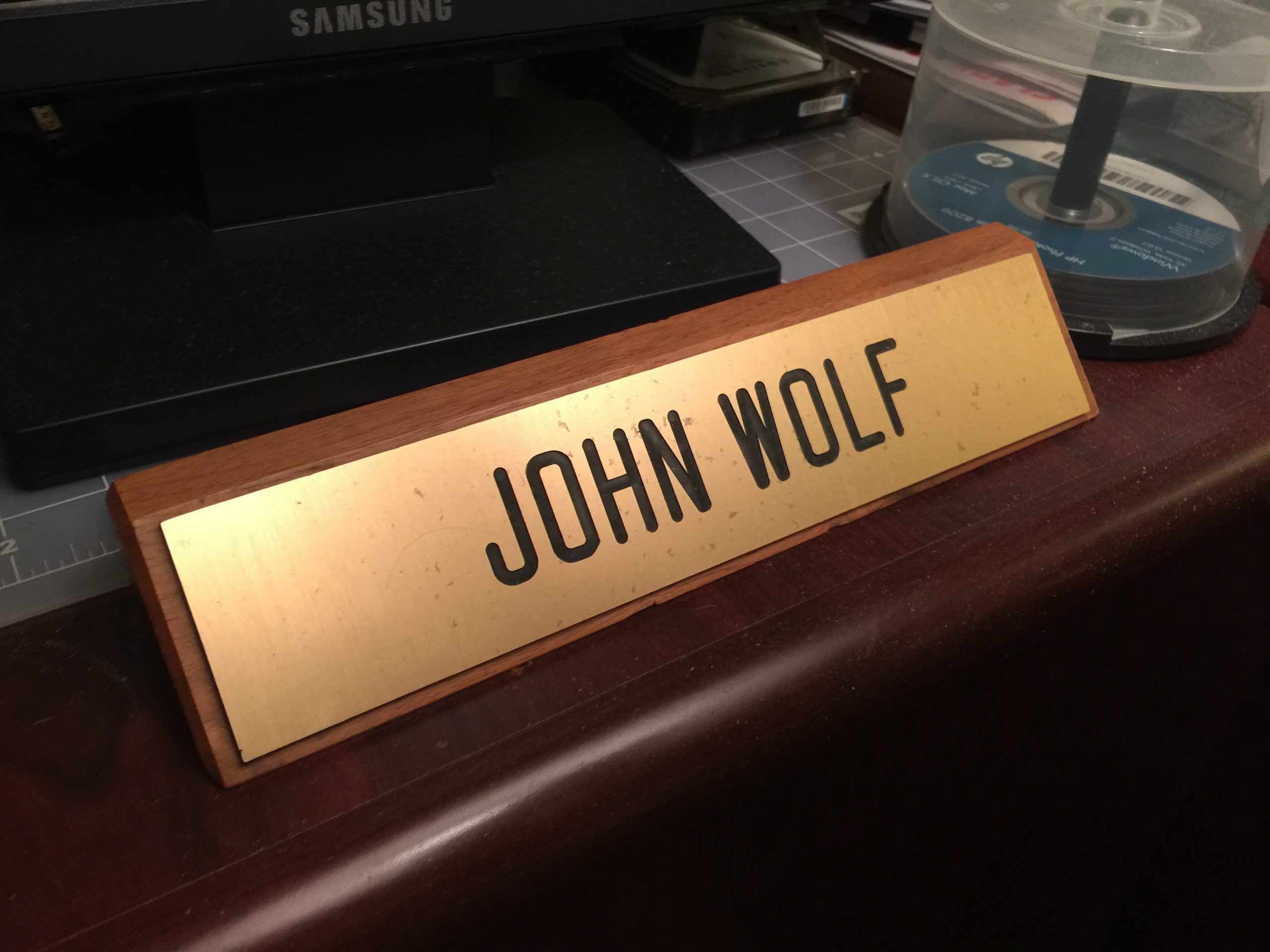
The Wolf of Derek Ave
Photo: the last time I saw Mr. Wolf at his home in Sarasota, Florida. November 24, 2015.
John Joseph Wolf II
February 21, 1949 – September 20, 2018
Ever had someone come along, invite you into their world, and change your life?
These are some memories of my time with “Mr. Wolf” — who was not only my boss from 1999-2006, but also like a father.
Like me, he was allegedly from Mentor, Ohio — but born in 1949. My mom swears he must have grown up knowing my uncle, since it was such a small town. I’d almost suspect Mr. Wolf and I were somehow related.
John’s creative passion and life’s work was a company he founded called Academic Publication Services. When I got my job there, it was at 5690 Derek Ave, off Clark Road in Sarasota.
The legend says he started the company himself in his apartment in Atlanta, at his kitchen table with a telephone and phone book. He was broke, slept on the floor, and built a multi-million-dollar company from nothing but his own obsessive ambition.
APS, as it was often called, provided colleges with printed items like job search handbooks, yearsbooks, and even the occasional poetry club magazine.
Here’s the secret ingredient: John was a master salesman. Every year, he and his sales team would generate large sums of money by selling advertising space in those publications. They’d sell business card size ads all the way up to full page and double-page full color spreads. It was surreal to experience the process from the inside.
Some would call the company a “Phone Room” or “Telemarketing.” But it was so much weirder than that.
It worked like this: John would go out at night around Sarasota. He’d meet someone, anyone, and tell them he could train them to become salesmen. That they could have a dream career writing their own paycheck. And he could, as long as they had the discipline. Most did not, of course! It took a special kind of strange mind to work those phones all day, “communicating with high level executives” as he called it. You would learn how to get on the phone with the CEO of Snapple or Taco Bell, and you’d make your case for why they should buy a full color ad in the back of your yearbook. If you followed John’s training, you’d go home with an incredible commission as well as helping support the university. Everybody profited, and the corporations barely noticed the money they spent — to them, it was almost like buying Girl Scout Cookies.
Working there was like being in Fight Club. It felt like a top secret business — selling advertisements in the backs of yearbooks. Who could make a ton of money doing that? Who would even think to try?
It was my job to design the ads, and compile all of the pre-designed ads, too. It was a huge responsibility, as large sums of money were spent. The last step of the process was me, and I had to assemble the product that would get delivered to the school. I must have learned every possible graphics trick to create pro materials out of 72 dpi logos pasted into PowerPoint documents, crappy images faxed to me, and random whimsical directions (“most ads are retangular. Can you make my ad a circle?”). We had strict guidelines, and we’d pretend to be demanding, but we’d honestly work with anything, if necessary. I’d re-draw logos from scratch, come up with stock photography (with no budget, somehow), and recreate fonts by hand — if I had to get in there and redraw a sentence of text in Illustrator, I’d do it. The detailed work I did was probably excessive. But we took it seriously. Whatever the client needed, I’d do it. I once (or twice?) drove to New Orleans and created an entire yearbook for a college, with the photos submitted from the students and families in every format you can imagine. Every single student at the college got their own page. That might sound like a cheesy project, but that’s a lot of baby photos to organize. I was paid to fill in whatever graphic design and pre-press gap there was. “Carl King can do it.”
But none of the work I did on a daily basis truly mattered to this story of my friendship with John Wolf. Forget the actual job description and paycheck.
Academic Publication Services was, at its foundation, a factory designed to improve Carl King.
I lost my father when I was 13, and 10 years later I was lucky enough to meet Mr. Wolf.
I met him the same day I abruptly quit college. On my way home from Manatee Community College in South Venice, Florida, I stopped at a gas station. I think it was called Super America. I bought a newspaper so I could look for jobs in the classified. For whatever reason, there was an ad for a Graphic Designer in Sarasota. I called. He answered. I told him I could use Adobe Pagemaker and had tons of experience working in a print shop. He told me to come in for an interview. I mention these mundane and even trite details only to point out how my life would have been completely different if I didn’t quit school that day, or buy that newspaper, or make that phone call.
When I first got a job at his company, I was a screwed up, quiet kid. Socially withdrawn, full of anxiety. I was a mess. I had serious anti-social behaviors. I wanted a music career, and I honestly had zero desire to be working for John Wolf and his Academic Publication Services. I just wanted to be left alone so I could do my work, get paid, and spend all the money on recording my music.
I did not fit in at his company, or even around him. We seemed to have nothing in common. Knowing him, he wanted the challenge. He hired me on the spot. “Can you start today?”
I don’t know why but he paid me DOUBLE what I was making at my previous job. (Don’t tell Michelle.) And oddly, when he showed me my office (he actually gave me two offices with 3 computers) I discovered he hired me before he even fired the previous guy. The other guy looked up as I was shown in. Hello? Oh. The other dude left that day and never came back.
By comparison, my previous job was straight-up abusive. I was made fun of by my boss and coworkers constantly. My “desk” was a cardboard box on the floor with my name written on it with a Sharpie. My boss and coworkers thought that was hilarious. They’d mock me and scream in my ear to startle me when I was working. It felt good to call them that day and say, “I got a new job.”
Overnight, I was probably making more money than them, which was funny to me.
Another funny detail, and he’d appreciate this: I didn’t know nearly as much as I claimed I did in the interview. But I was good with computers and could figure things out. He wanted me to work in Quark XPress. OK, I told him, “I can do that.” I bluffed my way through the day. After work I went straight to Barnes & Noble and bought a Quark XPress book and taught myself that night. It seemed like an insane thing to do at the time.
For some reason, I don’t know why, John Wolf instantly took an interest in me, as much as I didn’t want him to. He’d hang out by the door of my office a lot and give me mini-lectures, and I always thought “Who IS this guy?” It wasn’t normal. I’d be trying to work and he’d be asking me about my future and telling me about books I need to read. I’d never experienced anything like it. After work it was more lectures. I asked him once, what would you be if you didn’t work in sales? He answered: A teacher.
He was intimidating. He had blue eyes and made intense eye contact. He was a big guy, big facial features, like Tony Robbins. As you can see in the main photo of us, he was a giant. Sometimes it was hard to get a word in, because once he was on a topic there was no stopping him. He wouldn’t change topics until he was convinced you understood and could repeat it all back to him in your own words.
A few people from work would hang out with him after hours. If was often me, John, and the janitor Tom. It was under the pretense of a sort of “computer repair club.” I don’t remember doing much with computer repair. Just inhaling a lot of second-hand cigarette smoke. John had white boards hung all over the walls in every room. Wherever he happened to be standing and lecturing, he’d scribble concepts onto them. You couldn’t read his writing. By the end of the lecture he’d be pounding the dry erase markers into the board for emphasis until the tips were flat. He’d throw the dry erase marker in the trashcan and grab another one. Because of this behavior, the secretary had to keep tons of them in stock.
He was quite… dominant. One time he had the audacity to tell me he was my mentor. I thought, who is this guy to decide he’s my mentor? That’s so crazy.
He was the toughest and most intense boss I’ve ever had.
The salespeople he hired were colorful characters. There was Paul, Ted, Joe, and another Joe. They all went by multiple pseudonyms, with sort of assumed identities and backstories, which was another surreal dimension to APS. I learned that a talent for sales often manifests along with other personality quirks. I had to be careful of them using their skills on me. There was always some sort of psychological warfare going on in that back room full of telephones. Mr. Wolf’s secretary, Nancy, did her best to keep them under control during the day, before John came to work in the afternoon.
Years later, I saw the movie Moneyball and realized that was his exact strategy for APS. He found these oddball people and put their unusual abilities to work for him. But really, seriously, he was more focused on teaching people instead of focusing on doing business. It’s almost like the business part was secondary, a result of all the teaching. It sounds corny and that I must be framing him positively after his death but it’s true.
John liked to present people with seemingly impossible challenges, to teach them to question their imagined limitations. For example, if I had a technical problem beyond my control, I would say: “It’s broken. I can’t do it.” Those were the magic words. He’d answer: “Can’t do it? Solve it in 20 minutes or you’re fired, how about that?” He’d give me a scary look and walk out. Sure enough, he’d come back in 20 minutes, and I’d have the problem solved, probably shaking and sweating. He’d smile. “Ah! So it wasn’t impossible!” It was a terrible thing to do to an employee, but it worked and taught me a lesson.
“Ask the wrong question, get the wrong answer,” he loved to say.
I once stopped by his office at random in the afternoon. It was during one of those times we weren’t speaking. (We’d get in fights sometimes. He’d go too far and I’d finally stand up for myself and quit and try to prove I didn’t need him.)
On that occasion, he asked me to look at some graphics files for a project that was due. I ended up redoing the entire project from scratch for 24 hours straight. He’d be right there all night with me, doing his famous chain smoking and reheating the same 1/4 cup of coffee on repeat, never actually drinking it.
There was a weekend night with John that was iconic. 30 year old me would have otherwise sat at home by myself and made Dungeons and Dragons characters or something. He picked me up in his Infinity, and we drove to 7-Eleven. There, he bought Pork Rinds (!) and a single tall can of cheap beer. He got in the car, cracked open the beer, and put in a cassette of Jim Rohn called “Cultivating An Unshakable Character.” Here’s this guy in his Infinity, eating pork rinds, drinking a beer while driving around town, and listening to Cultivating An Unshakable Character. The irony.
He enjoyed taking me out to bars, where he would sit back and send me on missions to socialize. He’d pick out some random people in the crowd, and he’d say “Carl, see that guy and girl talking to each other? I want you to go over there and hang out with them.” He’d sit back and enjoy himself.
He was also a social prankster, like Eric Andre. But instead, imagine a tall, pale white guy in his 50s, with money, out on the town engineering awkward situations. John loved to see people uncomfortable. Not in a malicious way (most of the time), but in a “here’s an opportunity to learn about human behavior” way.
He was an instigator. He could read people. He could sense what would push people’s buttons and he’d go right up and push them. For instance, I remember us getting thrown out of a local bar because he walked right up to a bouncer who was a little overweight: John grabbed the guy’s gut with both hands and squeezed it. The bouncer wasn’t amused, didn’t budge, stared him in the eyes and made it clear that John needed to stop that.
Even though John was wealthy, he loved the worst DIVE BARS he could find. He’d pull up in his Infinity and he’d befriend everyone there. Any sad loner sitting by themselves, he go up and make friends. He was always high-fiving people. But he often pulled the corny “Too slow.” That was his favorite Dad joke. He never got tired of that one. I learned to never trust his high fives. When you got a genuine high-five from him, it was the greatest.
John usually had nice clothes, but would sometimes dress strangely on purpose. For instance, he’d sometimes wear an obnoxious hat that didn’t fit him and go out to bars and act normal. Sometimes it was a big cowboy hat, or a puffy trucker hat that clashed with his rich-guy attire. He didn’t need anything like that to stand out, as he was an unusually tall white guy. He stuck out everywhere he went.
He told me that when he was younger he and his friend would rub mud all over their clothes and then try to pick up girls. Who knows how true that is but I wouldn’t be surprised.
He was mischievous. I remember a company dinner party, at a fancy seafood place, where John threw lobster across the room at other tables. It seemed like it was just another opportunity for him to conduct a social experiment and learn something. He’d think: If I throw lobster across a restaurant, what will they do, and how will I get myself out of it? He loved those kinds of challenges. John really loved to create a social problem for himself and be forced to find a creative solution. He told me that many times.
Anywhere John went, there’d soon be a crowd around him. I don’t know how he did it. I wish I knew. Question: Where’s the party? Answer: wherever John was.
He could also be a bully. I was working one day in my office, and he decided he needed my lamp. He walked in, unplugged it, and walked out with it — without saying a word. No greeting, no apology. He left me sitting there at my desk in the dark, and I felt like Milton from Office Space. I’m sure he thought it was hilarious, but he paid me so well that I wasn’t going to complain.
I quit his company maybe 5 times over the years, usually in one of my silent temper tantrums, and he always took me back, no questions asked. As if to say, “are you ready to learn this time?”
John was obsessed with challenging his employees. He’d sense your weakness, bluntly tell you what it is, and then demand that you work in a way that strengthened you. He was so brutal and held nothing back in his criticism. If you had a natural talent, he wouldn’t let you use it. He’d say, “focus on your weak arm.” Eliminate weaknesses.
When he met a new person, it’s like he thought, “lemme see how I can improve them.” Didn’t matter if the person didn’t want improvement. Most of the time they didn’t, of course. But I’ve never met anyone else like that. Who goes around compulsively trying to improve people? What a hobby.
In addition to dry erase boards, John also liked to decorate the walls of his company with laser-printed slogans in Impact typeface on bright paper — Astrobright Fireball Fuchsia, for example. He’d scotch tape them up everywhere. From air conditioning vents, on cabinets, the water machine. Any time he came up with a cool philosophical thought from a book or motivational tape he’d plaster it everywhere. He loved Brian Tracy, Tony Robbins, Zig Ziglar — the mainstream stuff. However, if you were one of his top salesmen, and if you were lucky, he’d play you noisy old Dave Sandler recordings on his little cassette player. It was all improv stuff in front of a live audience. Conversational sales techniques, manipulative stuff. “See how I turned that around?” I’d hear bits of it but he wouldn’t let me listen to them. He always said I wasn’t ready. (Now I want those damned tapes!)
He had little standup signs on everyone’s desk that simply said I AM RESPONSIBLE. If he was in The “I Am Responsible” mood he wouldn’t help you with any problem you had. He’d just point to his forehead like the words were written there and read them to you. “I. Am. Responsible.” Then he’d throw you out of his office. You had to solve the problem yourself, and hope you were making the right decision. He didn’t allow “learned helplessness.” At least with me. I think he believed making a huge mistake would stop you from making the same mistake again, simply from suffering the consequences. You had to get a bloody nose or whatever.
At some point near the end of 2001, Mr. Wolf discovered the book Good To Great by Jim Collins. He came back from a short vacation and unplugged all the phones and shut company down for a week or two. He pushed all the tables together in the middle of the office and held all-day meetings about how to improve the company. People did not react well, as they were mostly paid on commission and didn’t want to hear all that stuff. Lots of yelling, some crying, and a couple guys quit and never came back. He referred to Good To Great as “The Book.” He threatened to fire people who didn’t read it. Some would even pretend they read it and try to bullshit him. It was such a wild situation. It was during that time that I finally “got it” and started reading business books, too. Once I was “on the bus” John and I clicked and were like best friends.
John liked to carry a big wad of $100 bills in a black binder clip. Not a fancy money clip… one of those cheap black binder clips from his office. He used it as a prop while telling stories. I’ll never see a binder clip and not think of him. At work, we used them for binding all the sales leads together, when they were given out to the sales people every day. Those clips were always around him, serving one purpose or another.
He liked to pull out the cash and try to challenge people to do stuff. Like, if you can ____ I’ll give you $100 right now. Unfortunately I don’t remember the challenges. I’m sure they were interesting and unique.
He also liked to hand people the keys to his company. “If you can run my company, I’ll pay you (I don’t remember what the number was, maybe $300k) a year. Here are the keys. Can you do it?” Uh, no. No one could do it. I think it was his biggest puzzle in life. It would have been an incredible joy for him to find another John Wolf. He always said he wished he could clone himself.
Even though he drove an Infinity, he sometimes drove a old 70s station wagon he called The Enterprise. He somehow kept that thing in mint condition. I found out later it was his dad’s car, and he kept it in great condition all those years for sentimental value.
John had some intense hobbies, too. His house was filled with aquariums, and those aquariums were filled with guppies. He knew everything about them. He’d breed them. No idea what he did with them afterwards but he sure had a shitload of them.
Another obsessive hobby: he loved using audio tools to clean up and make perfect digital recordings of his favorite disco / smooth R&B songs. I did not share his taste in music. He seemed to be trapped in the 70s but that’s what he loved.
He wanted everyone to hear those cleaned up digital files. At the end of a good sales week he’d open up WinAmp on his PC and blast “Eveybody Dance Now!” and “I’ve Got The Power!” from his stereo. It was very loud and very cheesy. As socially adept as he was, John was paradoxically somewhat of a nerd. He’d dance around the room in his turtleneck and try to get people fired up.
Coincidentally, we never did talk music. It was my favorite subject in the world, but John never knew me as a musician. He claimed to play keyboards. I don’t know if that was true. I avoided the subject. To be honest with myself, I was scared he would tell me my music was bad.
Speaking of music, my Sir Millard Mulch album “How To Sell The Whole F#@!ing Universe To Everybody… Once And For All!” was directly inspired by him, and often about him.
Another eccentricity: He had big vitamin bottles everywhere. In his car, all over his desk. He believed he could cure anything with them. He was a self-professed chemistry geek and didn’t trust doctors. I don’t remember how much vitamin C he took every day, but he referred to it as Mega-doses. “Mega-doses of vitamin C” he said all the time.
Here’s another thing: John liked being President. He was president of not only Academic Publication Services, but also President of the International Fancy Guppy Federation In Atlanta. President was somehow a word that resonated for him. Years later, when I started my little LLC, I had to pick an official title for myself. I chose Carl King, President. It was because of him. I see it and think of him every time I write a check. Funny little thing. I wonder if anyone thinks I’m pretentious calling myself President, but for me it’s an inside joke.
He sometimes had no manners. I recall him eating salad with his hands, and flicking the ranch dressing off of his fingers into the trash can at his desk. He was such a big and imposing dude, he could get away with anything.
Another little charming habit Mr. Wolf had: When he was making a phone call, he never put the phone to his ear. He used the speakerphone. He seemed to especially love beating up on tech support or printers. Being on the other end was like having Darth Vader force-choking you. He was either making you feel like a piece of dirt (if he thought you were playing games with him) or making you feel loved. He had that power. He could connect directly into people’s minds and trigger fear. I don’t know how someone could do that but I’ve never met anyone else with near that level of Jedi ability. John could do anything in any social situation and come out on top. I have sometimes thought that it’s good I can’t do that, because I’d be dangerous. Anyone would be.
One of his techniques for intimidation was “not quite hearing what people said.” I never figured out if it was intentional, but it WORKED. He’d make a concentrated, strained face like maybe you were crazy, or maybe you didn’t exactly know what you were talking about, and he’d make you repeat yourself. Like “it’s YOUR fault I don’t know what you’re saying.” It threw you off balance and made you self-conscious, like that trick of asking a tennis player about their grip, a pre-game sabotage psyche-out. He’d listen intently and judge each word you chose. Then he’d respond in some way that made you feel he didn’t even hear anything you said! You’d give up on trying to correct him as he plowed forward. Maybe he really had a hearing problem. I don’t know. The speakerphone thing also fit with his “I can’t hear you and it’s your fault” technique, as he could never quite understand the person on the other end of the phone. He would habitually pound on the volume-up button, even though it was always on maximum.
Over the years he gave me a few private “here’s why I can make money and you can’t” lectures as brutal as Alec Baldwin in that movie Glengarry Glenross. Underneath all of it, there was good intent. If you could resist getting offended you could learn something.
When I moved out to California and got offered a book deal, I called him and asked for his advice to negotiate the terms of my contract. A better royalty, better something. As a first time author you don’t get much, and I felt like Mr. Wolf could help me. Surely, the world’s greatest salesman knows what to do! I began to explain. But John, interrupting me, replied: “Carl. CARL. Sign the fucking contract and say thank you, then write the best book you can.” Then he hung up on me! Wow. I signed the contract, wrote the best book I could, and then I dedicated it to him.
John was vastly generous. He’d pay for dinner: always. He’d pay for everyone around him. He was good at finding some reason to write me a bonus check.
At the end of a long night of going to every dive bar in town, we’d end up at Waffle House out by I-75 at 3 am. With his money, he could have eaten anywhere, hired a helicopter and chef, but he was fine with the cheap stuff. He lived in a fancy neighborhood, drove a fancy car. But I never knew him as a wealthy person that hung out with other wealthy people. He would tell me, “I can go anywhere, fit in with anyone.” I think he truly preferred hanging out with blue collar workers, and the challenge of running them through his improvement factory. That was his thing: how can I take this random guy I just met and make him better? Every day, all day. He never stopped.
Years after I had moved on from working for him, I still called him “my boss.” I’d still address him as Mr. Wolf when I called him. Coincidentally, probably one of his last publications for a college, I assembled for free. He emailed me all the ads out to California and I sent them back as a PDF. Did my same old job. Didn’t charge him, and it was fun to think I was still there helping him in some small way.
I heard a vague rumor that he thought of me as a son. I surely thought of him as my adopted father. He once told me with tears in his eyes: “you’re gonna make it, Carl King.” How could I ever forget someone telling me that?
Here I am almost 20 years later — still listening to Jim Rohn lectures, trying to connect to the world in the way John Wolf did.
Maybe knowing John Wolf the way I did was like knowing someone that was completely different from everyone you’ve ever met. Maybe it was like meeting a historical figure, someone like Frank Zappa, and getting to join his band.
Coincidentally, I once played Mr. Wolf the Frank Zappa audio that later became my animated “Aisle Or Window” cartoon. His immediate response: “See?! That guy gets it!”
He was 50 when I met him. It’s crazy to think that as I am writing this, I am 51. How would I relate to him at this age, if I could go back in time and walk into his office on Derek Ave? I wonder this sometimes about my own dad. Would we have gotten along as adults? I actually doubt it.
From what I know, John had two sons and three daughters who lived in other states — in Georgia and perhaps Ohio.
Aside from his daughter Kristin (who is awesome, by the way), I wonder how well they actually knew him. I was lucky to have him in my life and career. I would not be the same person if he had not come along and decided he was my mentor.
Thank you, John Wolf, President.