I turn 51 next month. I’m grateful that my life is so simple.
How did it get that way?
A lot of my best choices in life were acts of omission.
Not purchasing things. Not signing up for things. Not automatically saying YES to things.
Traps for my time, energy, and money are everywhere.
As I age, I get better at avoiding them. My minimalism becomes… uh, more (?) minimalistic.
But sometimes I’m tempted.
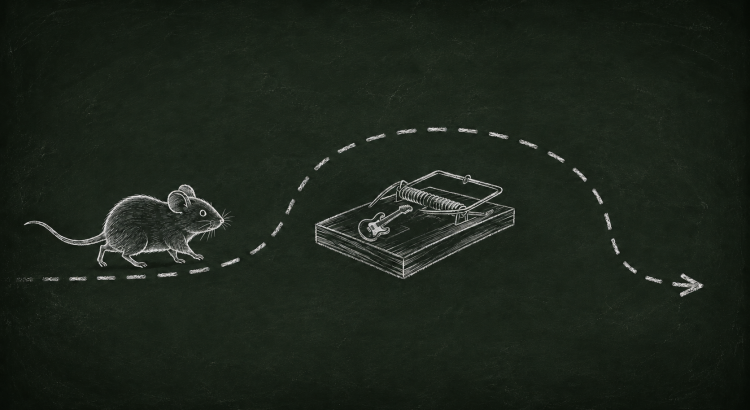
I recently spent weeks drooling over a $3,000 guitar I had wanted since I was a kid. They’re old and hard to find. Only a few are currently for sale in the United States. I discovered one in Town-I’ve-Never-Heard-Of, Texas.
Twice, I started driving to the guitar store to make them order it for me.
Both times, I had just enough judgment to turn the car around.
I know I’d enjoy that guitar for a month. I even wanted to play it on my new album.
But I know myself too well: it would end up in a case like the other ten guitars I never use.
One more thing to carry up and down stairs the next time I move.
The truth?
I’d rather save the money.
As Benjamin Franklin didn’t quite say, “300,000 pennies saved is 300,000 pennies earned.”
Invest that money in an index fund, assuming historical averages, and it would double in seven years.
As a thought experiment, imagine if you did that with everything you decide not to buy. Well, it’s not just a thought experiment: that is exactly how folks in the F.I.R.E. movement become millionaires and retire early.
Just by not doing things. Over and over.
Two quotes from Warren Buffett:
1 – “An investor needs to do very few things right as long as he or she avoids big mistakes.”
2 – “Our satisfactory results have been the product of about a dozen truly good decisions—that would be about one every five years.”
Most days, his job is to go into the office… and wait. He doesn’t look like he’s investing.
It’s counterintuitive, but much of his success comes from strategically not doing things.
Conversely, give an amateur investor a million dollars and they will likely “do a thing” with it right away. Surprise: it’ll soon be gone.
That’s because we are cursed with action bias: we prefer action over inaction, even when doing nothing might produce the better result.
I’m no Warren Buffett, but I decided that $3,000 guitar is better off in Town-I’ve-Never-Heard-Of, Texas.