When I was a teenager, I was a follower of Ayn Rand.
I knew everything!
(I left that cult, but continued my fascination with critical thinking.)
I’m learning how important it is to say, “I don’t know.”
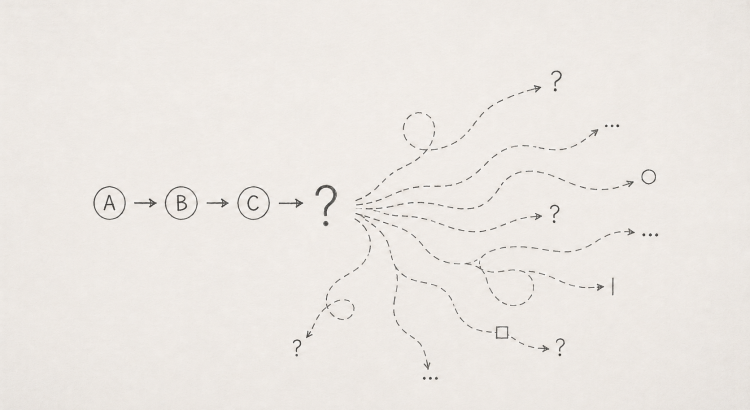
Our operating system for understanding the world is stories. Chains of causality. A, B, C… and then…?
It’s too easy to think we can predict what will happen next.
Maybe A again. Maybe V. Maybe nothing!
Jumping to conclusions is the default. It’s an evolutionary advantage. It got us far.
But how many times a day do we do it without knowing?
Is it sometimes better not to?
Yes, when it becomes apophenia or patternicity.*
Or even more fun, conspiracy theories.
I’ve been reading Howard Marks, and I’m struck by his intellectual humility. His ability to say, “I don’t know” permeates his prose. (Ironically, I notice that the more someone knows about investing, the more they say that.)
Not knowing yet, and being able to admit it, can be the price you pay to eventually figure something out. No amount of vestigial confidence or machismo leads to understanding.
Even an abundance of evidence can, and often will, lead us to the wrong answer.
For example, it’s exciting to believe we know what Artificial Intelligence will cause.
Or what bombing Iran will cause.
Or what anything will cause.†
Maybe we shouldn’t commit to the first simple narrative that pops into our minds.
It’s more difficult to predict second-order effects, perverse incentives, emergent behavior, feedback loops, exogenous shocks, black swans.
But they happen.
Sci-fi author E.M. Forster imagined The Internet in 1909, but not how stupid social media would be.
*Coined by Michael Shermer.
†As Howard Marks writes in The Most Important Thing: “Even if it’s possible to know which one outcome is the most likely, the others have a substantial combined probability of occurring instead.”